

Elevator Online Monitoring & Intelligent Fault Diagnosis
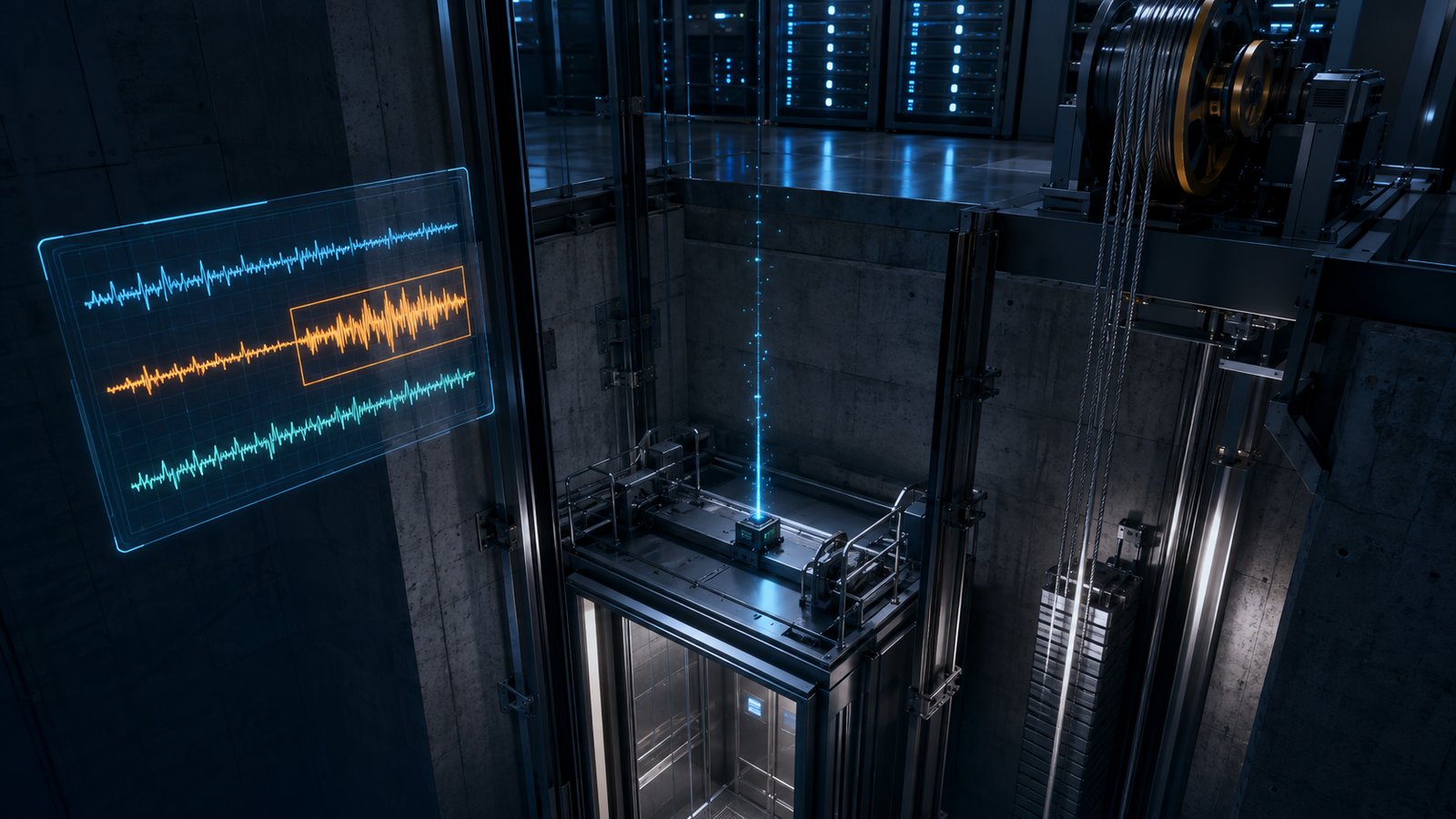
Elevators are among the most frequently used and safety-critical assets in high-rise buildings, yet fault samples such as shaking and emergency stops are scarce, and signal patterns vary widely across elevator models and service ages — thresholds and single-model approaches struggle to keep up. The team links car-mounted triaxial accelerometers, intelligent visual monitors, and a centralized monitoring platform into a live system, with an Attention-based Multi-Task Learning Bidirectional Long Short-Term Memory network (AT-MTL-BiLSTM) at its diagnostic core that automatically zeroes in on the critical moments around fault onset. Validated on operational data from real in-service elevators, the system achieves accuracy, recall, and F1 scores above 0.94 for all three fault types: front-back shaking, left-right shaking, and emergency stop.
Project Overview
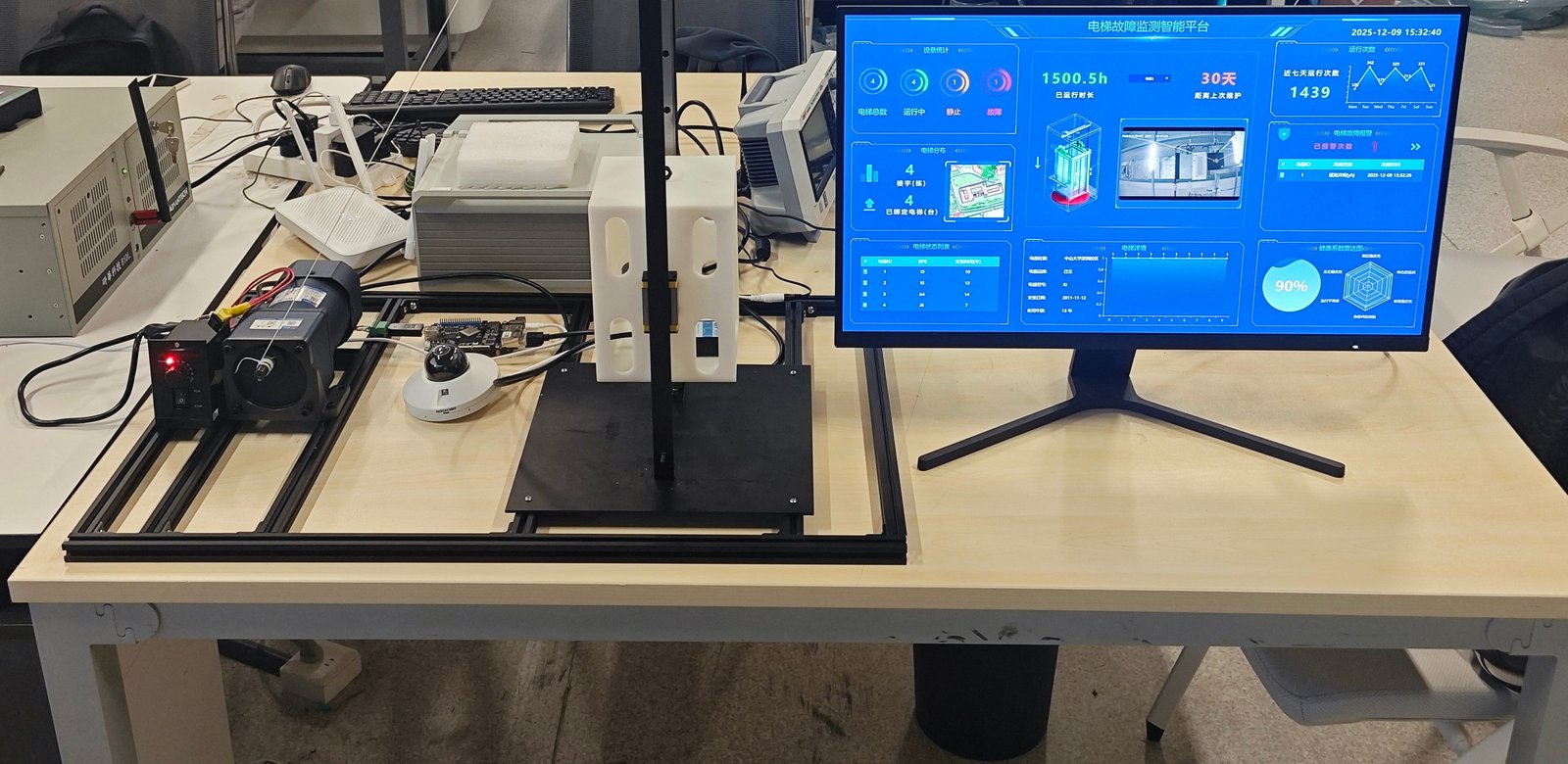
When an elevator malfunctions, maintenance crews typically learn about it only after a passenger complaint or an entrapment alarm — early signs like mild shaking go unreported and unrecorded. This project mounts triaxial accelerometers and intelligent visual monitors on the car, streams operational data to a centralized platform, and runs a deep-learning model that identifies fault types online while assessing anomaly status and severity. The three characteristic faults — front-back shaking, left-right shaking, and emergency stop — are naturally imbalanced; attention mechanisms and multi-task learning shore up discriminability under low-sample conditions, and an elevator simulation testbed in the lab has completed end-to-end integration.
Research Objectives
Online acquisition and aggregation of car triaxial acceleration and visual signals
Accurate identification of front-back shaking, left-right shaking, and emergency stop faults
Diagnostic generalization under scarce and imbalanced fault samples
Simultaneous output of fault type, anomaly status, and severity level
Methodology
Triaxial acceleration time series from the elevator car are segmented into fixed-length samples via sliding window and fed into a Bidirectional Long Short-Term Memory network (BiLSTM), whose forward and backward hidden states are concatenated to capture both long-range dependencies and local transients. A temporal attention layer computes per-step weights and produces a weighted-sum shared representation focused on the critical moments around fault onset. This representation simultaneously drives three task heads — fault classification, anomaly detection, and severity regression — trained end-to-end with a weighted joint loss.
Technical Approach: How It Works
- 1
Turn Elevator Shaking into Measurable Signals
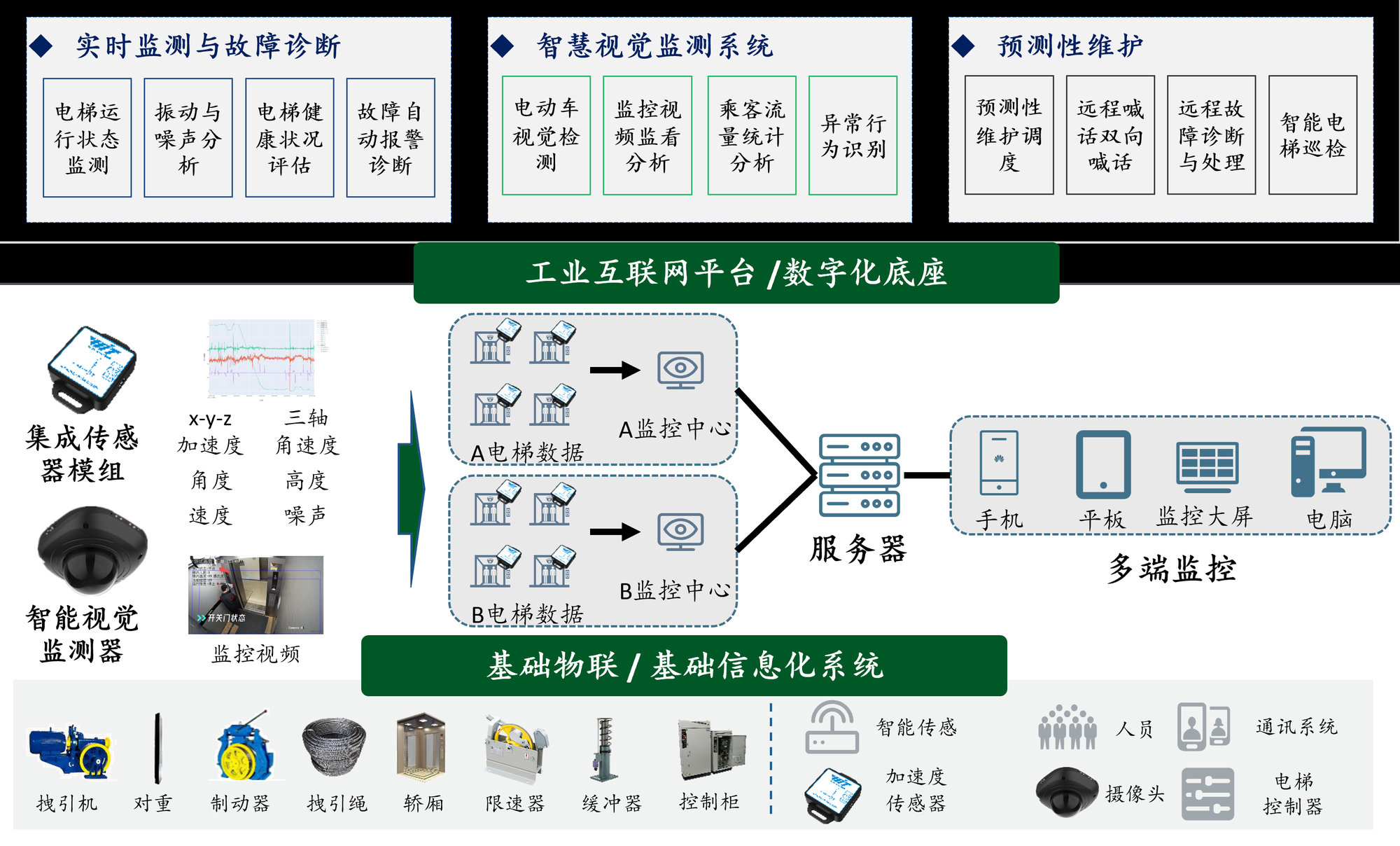
An integrated sensor module mounted on the car captures X, Y, and Z acceleration along with angular velocity, angle, speed, and noise channels; an intelligent visual monitor simultaneously records door operations and cabin footage. Professional maintenance personnel labeled operational data from multiple in-service elevators segment by segment, producing several real-world datasets.
- 2
Let the Model Find the Seconds That Matter
Elevators of different service ages exhibit faults at different time scales, requiring adaptive window lengths. A Bidirectional LSTM (BiLSTM) reads each window in both directions; a temporal attention layer then scores every time step, concentrating weight on the critical moments around fault onset while suppressing noise. The attention weights themselves are interpretable, revealing exactly which segment drove each diagnosis.
- 3
Three Tasks, One Model — Accurate with Few Samples
The primary task classifies fault type, while auxiliary tasks detect anomaly status and estimate severity; all three tasks share one representation and are trained jointly. The auxiliary tasks force the shared layers to learn more generalizable features under small-sample conditions, compensating for the bias introduced by scarce, imbalanced fault samples.
- 4
From Algorithm to a Deployable Platform
Diagnostic outputs feed back into an industrial IoT platform: a monitoring center aggregates data from multiple elevators, the server processes it centrally and pushes results to phones, tablets, large-screen dashboards, and desktops for real-time condition monitoring, health assessment, and automatic fault alerts, with extensions toward predictive maintenance scheduling and remote fault handling. An elevator simulation testbed in the lab has completed end-to-end integration of sensing, vision, and the platform.
Figures: Methods & Results
Key Results
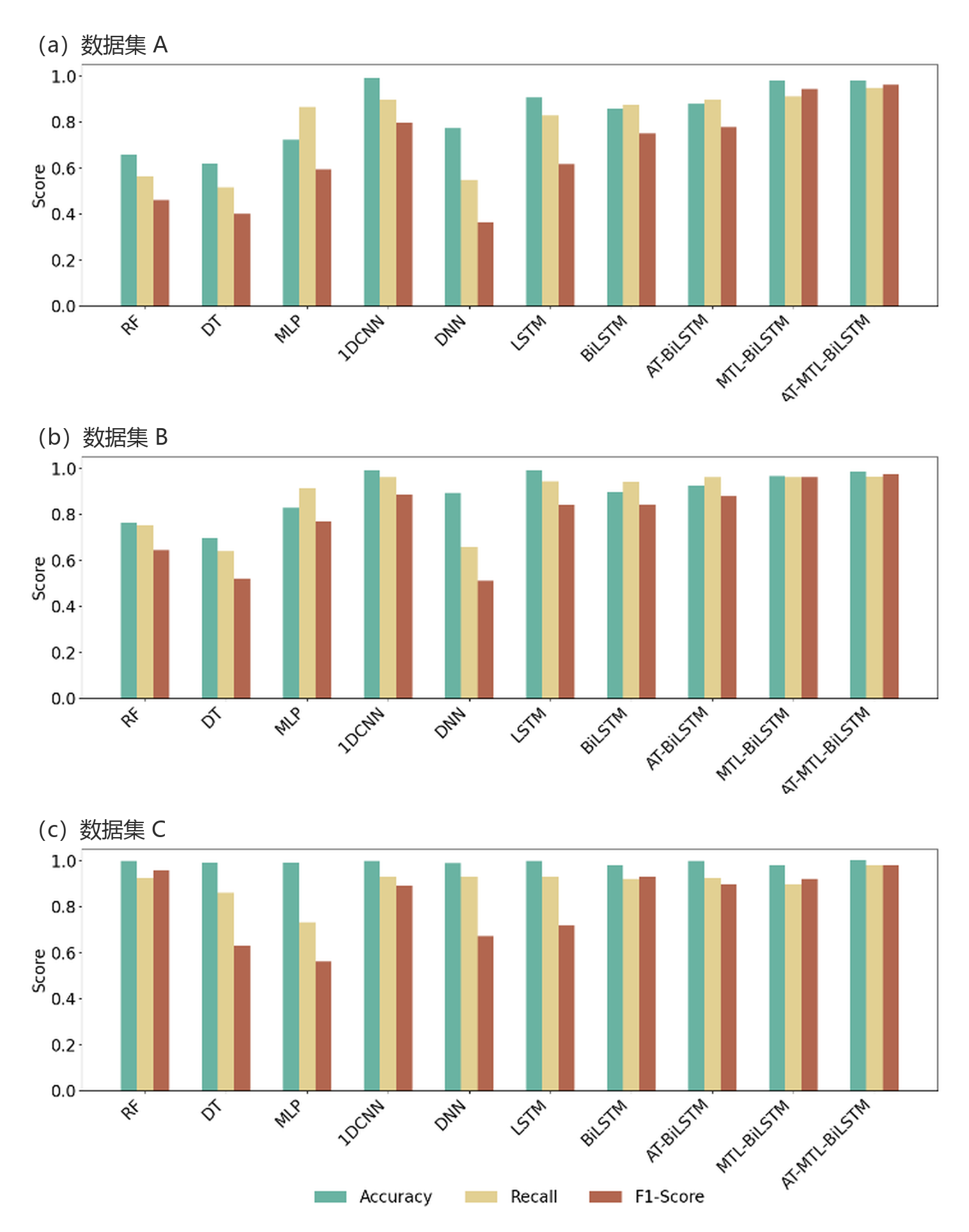
Accuracy, recall, and F1 above 0.94 for all three fault types
Best-case classification accuracy of 100% with recall of 0.981 and F1 of 0.980
Attention mechanism improved diagnostic metrics by approximately 3%; multi-task learning further boosted performance on low-sample fault categories
Related work published at the 21st International Manufacturing Conference in China (October 2025, Guangzhou)
Related Publications
An Attention-based BiLSTM Multi-task Learning Model for Elevator Fault Diagnosis, Proceedings of the 21st International Manufacturing Conference in China, 2025
Online Equipment Fault Diagnosis