

Servo Motor Online Monitoring & Predictive Maintenance
Servo motors are the joints of automated production lines, and their faults typically first surface as weak signatures in current and vibration signals. Following a "digital signal processing + expert rules + machine-learning enhancement" roadmap that starts from Motor Current Signature Analysis (MCSA), the team fuses fault-mechanism knowledge with strongly generalizing classifiers to deliver online motor monitoring and predictive maintenance, while evolving toward a next-generation paradigm of LLM-based retrieval-augmented diagnosis and representation learning. The technology now serves thousands of motors across hundreds of models, deployed at scale on production sites in papermaking, wind power, PCB manufacturing, precision forming, and other industries.
Project Overview
Servo motors are the joints of automated lines, yet signal variability across machines and operating conditions on complex shop floors often defeats pure deep-learning methods. This project holds to an engineering-first route of digital signal processing, expert knowledge, and machine learning — reading motor health from current and vibration signals, turning maintenance from fix-after-failure into replace-before-failure — one methodology now serving thousands of motors across hundreds of models on production sites in papermaking, wind power, PCB manufacturing, and beyond.
Research Objectives
Multi-parameter online motor condition monitoring based on MCSA and vibration analysis
Codifying fault-mechanism expertise into rules and a precise feature system
Cross-machine, cross-condition diagnosis powered by strongly generalizing classifiers and incremental learning
Exploring a next-generation paradigm of LLM retrieval-augmented diagnosis and representation learning
Methodology
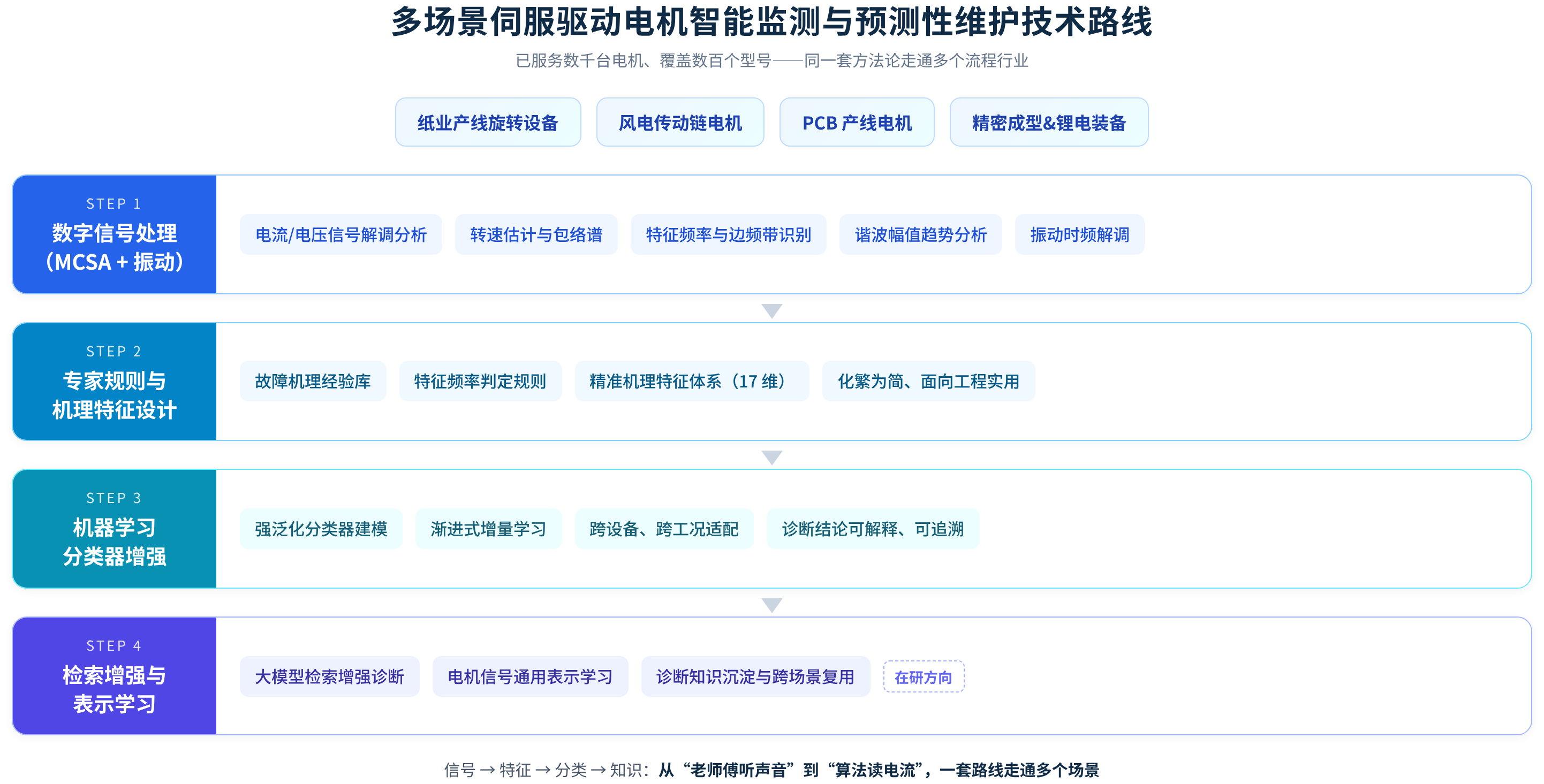
Current/voltage demodulation and vibration time-frequency analysis extract fault characteristic frequencies with their harmonics and sideband trends; expert experience is codified into decision rules and mechanism-informed features feeding strongly generalizing classifiers with progressive incremental learning; ongoing work introduces LLM-based retrieval augmentation and representation learning to consolidate and reuse diagnostic knowledge across scenarios.
Technical Approach: How It Works
- 1
Teach Algorithms to Read Current and Vibration Signals
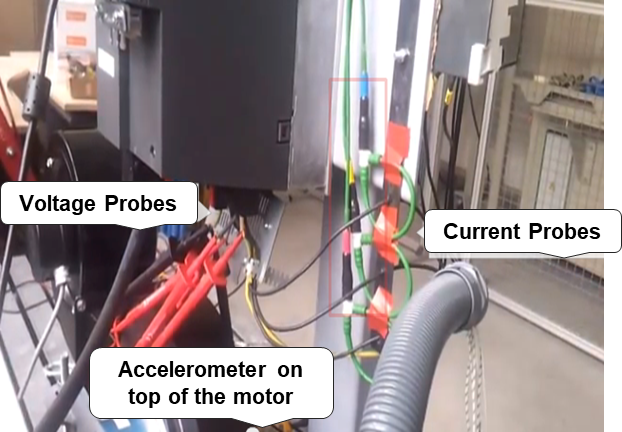
Built on Motor Current Signature Analysis (MCSA) and vibration analysis: current/voltage demodulation estimates rotating speed and extracts envelope spectra, identifying fault characteristic frequencies, sidebands, and harmonic amplitude trends — insight into motor health without stopping the machine or adding many sensors.
- 2
Turn Veteran Expertise into Decision Rules
Fault-mechanism experience is codified into characteristic-frequency decision rules and a precise mechanism-informed feature system (e.g., 17 features covering bearing damage, looseness, abnormal friction, and poor lubrication), simplifying aggressively to balance diagnostic accuracy with the real-time demands of industrial platforms.
- 3
Machine-Learning Classifiers Take Over and Keep Improving
Mechanism features feed strongly generalizing machine-learning classifiers, combined with progressive incremental learning to adapt across machines and operating conditions — sustaining high diagnostic rates and explainability on complex shop floors where pure deep-learning approaches commonly fail.
- 4
Toward Retrieval-Augmented Diagnosis and Representation Learning (Ongoing)
Joint research with partner teams advances LLM-based retrieval-augmented diagnosis and universal representation learning for motor signals, consolidating diagnostic experience scattered across scenarios into retrievable, reusable intelligent assets.
Figures: Methods & Results
Key Results
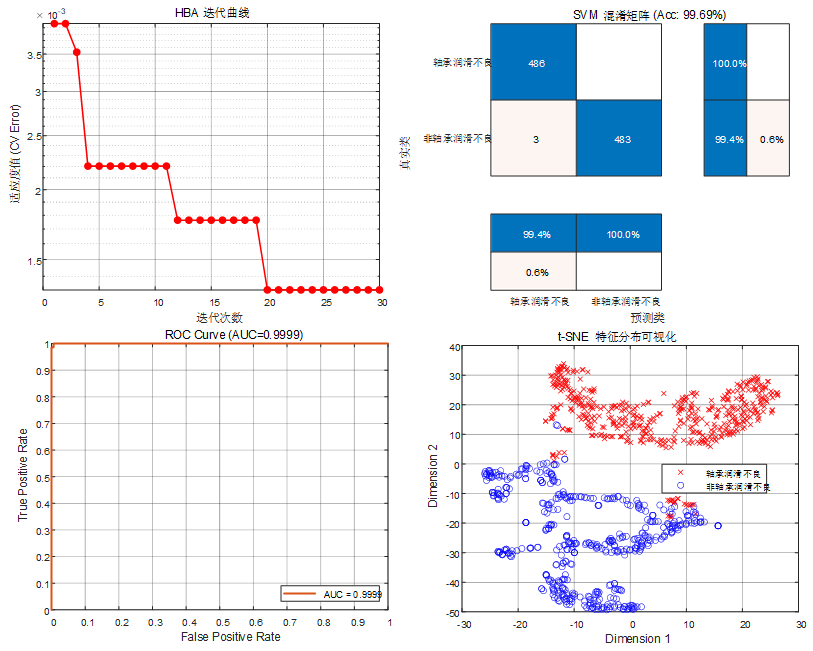
Recognition accuracy of 95% for typical faults such as bearing lubrication deficiency, with diagnostic models packaged and embedded in enterprise production systems
Thousands of motors served across hundreds of models, deployed at scale in papermaking, wind power, PCB manufacturing, precision forming, and battery-plant equipment
Joint research on retrieval-augmented diagnosis and representation learning is actively advancing
Online Equipment Fault Diagnosis