

Multi-Agent Online Diagnosis and Adaptive Process Optimization for Additive Manufacturing
Three collaborating agent classes — monitoring (PMA), diagnosis (EDA), and compensation (DSA) — form a closed loop that takes additive manufacturing from intrinsic sensing to adaptive process-parameter compensation

Project Overview
Existing additive-manufacturing solutions rely solely on surface-level monitoring (warping, stringing, layer misalignment), and purely data-driven black-box models lack root-cause diagnosis and closed-loop compensation. This project builds a "monitor–diagnose–compensate" closed loop coordinated by three agent classes.
Research Objectives
Intrinsic sensing and anomaly grading fused with an endogenous time-series large model
Precise root-cause diagnosis combining knowledge graphs with physical verification
Adaptive process-parameter compensation within safety bounds
Methodology
The monitoring agent (PMA) performs intrinsic sensing and anomaly grading; the diagnosis agent (EDA) pinpoints root causes via knowledge graphs and physical verification; the compensation agent (DSA) maps out adaptive compensation strategies and executes them in closed loop within safety bounds.
Technical Approach: How It Works
- 1
PMA Monitoring Agent: Intrinsic Sensing
Time-domain statistics (mean/variance/peak/RMS), spectral features (power spectral density/dominant frequency/spectral entropy), and channel-coupling features (correlation/energy ratio) are extracted and fed into a time-series large model that outputs a three-tier verdict: normal / minor anomaly / severe anomaly.
- 2
EDA Diagnosis Agent: Root-Cause Localization
Leveraging an additive-manufacturing process knowledge graph and physical verification, surface-level defects (warping, stringing, layer misalignment) are traced back to their process root causes, yielding an interpretable diagnosis.
- 3
DSA Compensation Agent: Closed-Loop Execution
Diagnostic conclusions are mapped into adaptive process-parameter compensation strategies and dispatched in closed loop within safety bounds, completing the full "monitor–diagnose–compensate" chain.
Figures: Methods & Results
Key Results
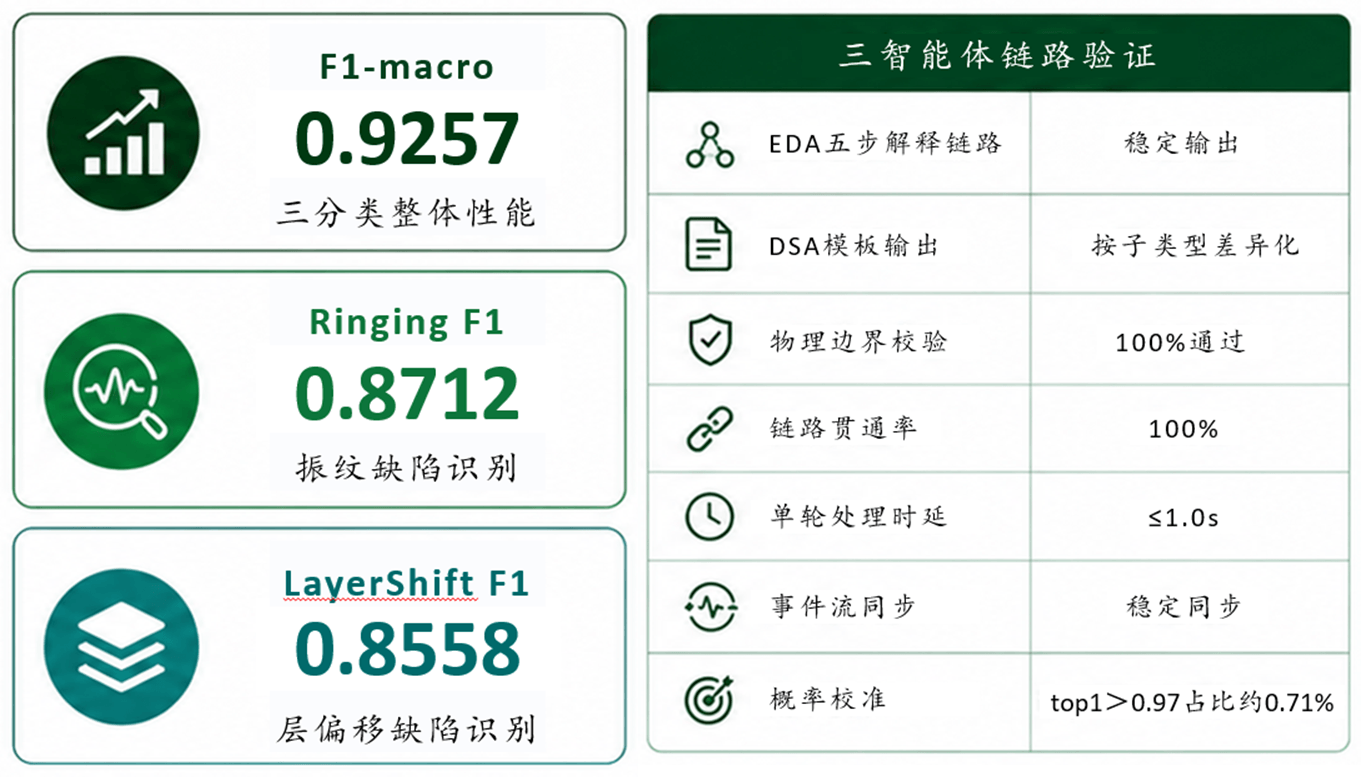
Overall three-class F1 of 0.9257, with per-defect F1 of 0.8712 for ripple defects and 0.8558 for layer-shift defects (validated through the three-agent pipeline)
The multi-agent collaborative closed-loop control system has completed demonstration validation
The direction has produced 2 high-level SCI papers and 4 granted invention patents to date; outcomes have been productized at leading equipment and technology enterprises
Real-Time Optimization of Production Operations