

Offshore Wind Farm Maintenance Scheduling Optimization
Offshore turbine maintenance faces a costly dilemma — service too early and production is wasted, too late and turbines sit idle — while conventional schedulers ignore the hidden cost of turbine production loss. The team built a globally optimal scheduling model that jointly accounts for production loss, overtime labor, and vessel travel cost, solved by a purpose-built genetic algorithm. Validated on real offshore wind farm data, the system outputs complete maintenance Gantt charts, vessel routes, and technician assignments, and has been productized with a leading wind-power enterprise.

Project Overview
Every offshore maintenance trip is expensive: service too early and production is wasted, too late and turbines sit idle — and the electricity not generated during downtime is a hidden bill that conventional schedulers ignore. This system builds a globally optimal scheduling model that quantifies that hidden loss with real power curves and wind forecasts, so every trip out to sea counts.
Research Objectives
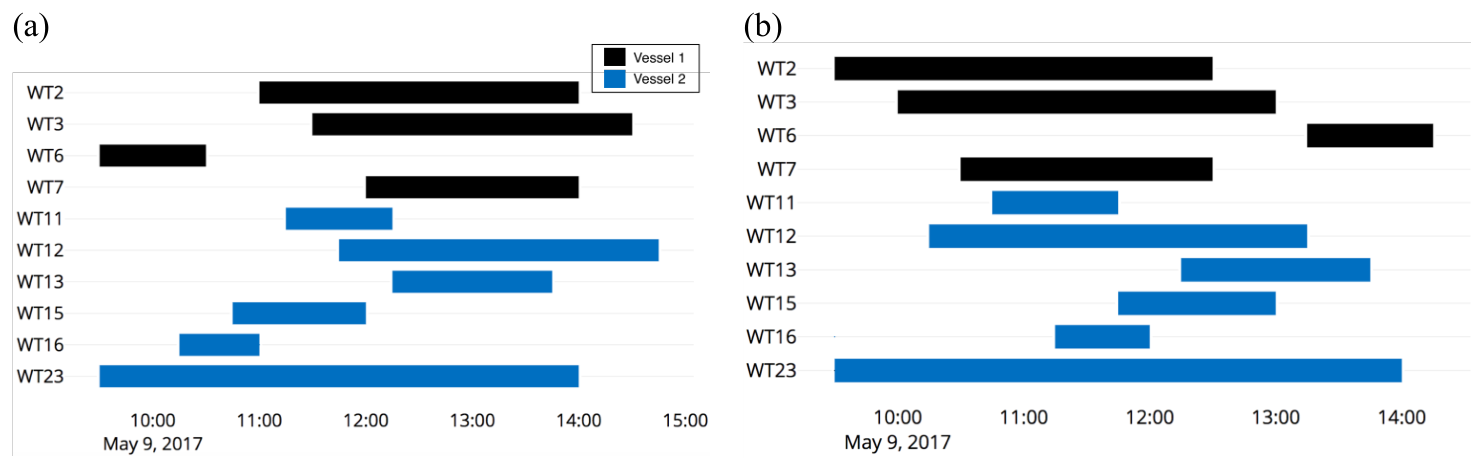
Build a production-loss-aware model for maintenance windows and task priorities
Jointly schedule maintenance routes, vessels, and technician crews
Automatically generate globally cost-optimal schedules with full cost breakdowns
Methodology
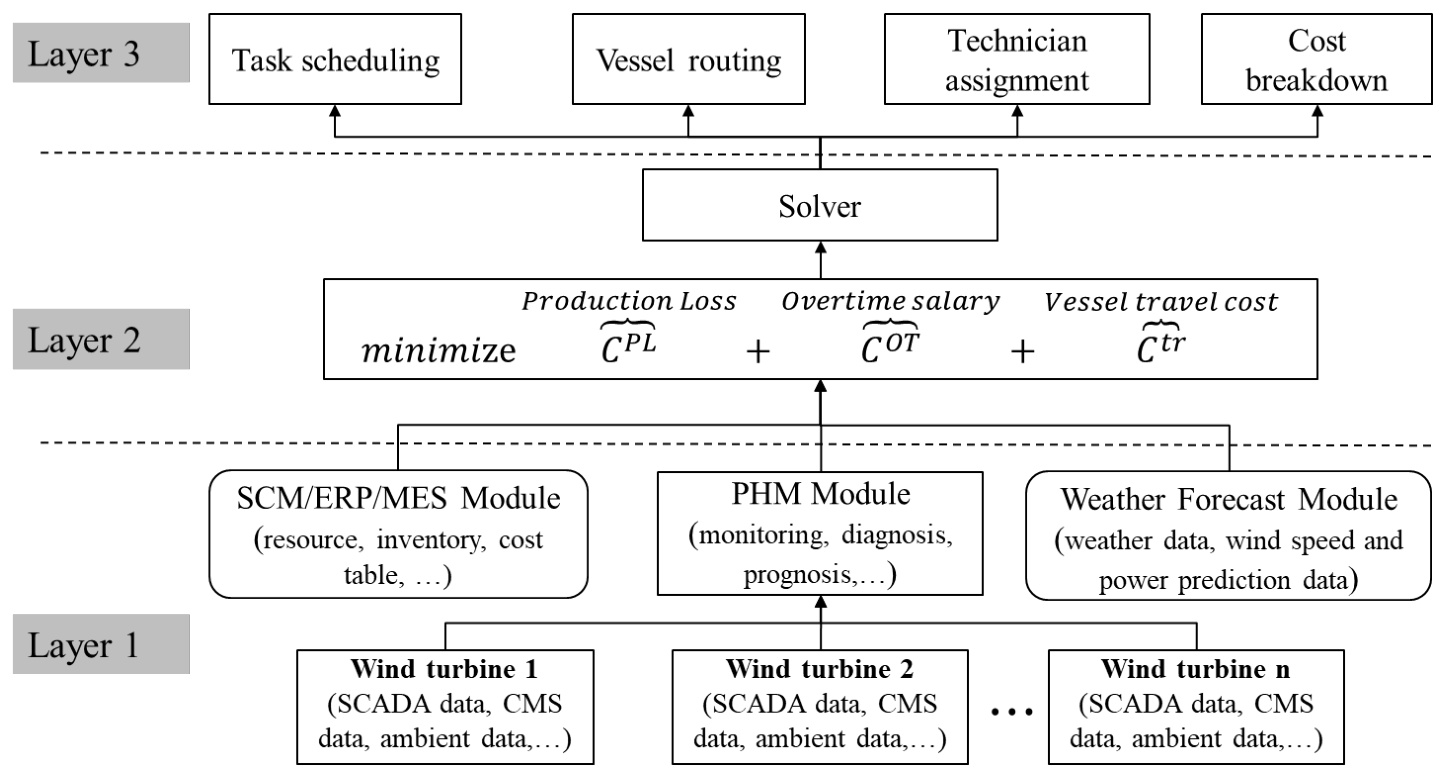
Power-curve monitoring and wind-speed forecasting quantify each turbine’s production loss before and during maintenance; a mixed-integer optimization model jointly covering production loss, overtime labor, and vessel travel cost is solved by a genetic algorithm with maintenance sequence and vessel waiting time as decision variables.
Technical Approach: How It Works
- 1
Make the Invisible Loss Visible
The gap between healthy and degraded power curves, combined with 3-day wind-speed forecasts at 15-minute resolution, quantifies each turbine’s production loss before and during maintenance. This hidden loss can account for roughly 40% of the overall maintenance cost, yet conventional schedulers routinely ignore it.
- 2
A Three-Layer Architecture from Data to Decisions
The bottom layer ingests per-turbine SCADA, condition-monitoring, and ambient data; the middle layer combines a PHM module that generates maintenance tasks with weather-forecast and SCM/ERP/MES modules that supply weather windows and resource constraints; the top layer’s optimizer outputs schedules, vessel routes, technician assignments, and cost breakdowns in one pass.
- 3
Mixed-Integer Formulation with a Custom Genetic Algorithm
Maintenance sequence and vessel waiting time are encoded as two families of decision variables in a purpose-built genetic algorithm (GA) solver, replacing hours-long commercial-solver runs and delivering near-optimal executable plans within minutes even at large scale.
- 4
From Shortest Route to Lowest Total Cost
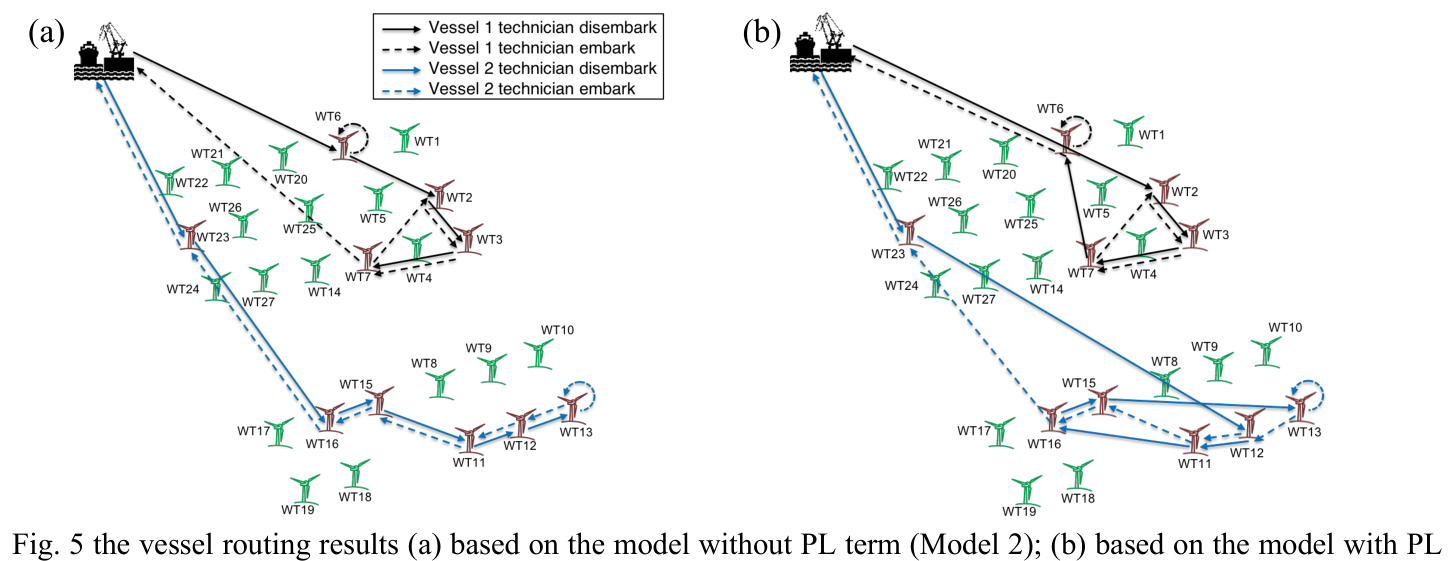
The solver prioritizes turbines with high production loss even when they are not closest to the harbor. On real data from a farm with 27 turbines of 4 MW, the schedule cut total cost markedly versus a production-loss-blind baseline, with overtime cost driven to zero.
Figures: Methods & Results
Key Results
Validated on real data from an offshore farm with 27 turbines of 4 MW: production loss accounts for roughly 40% of overall maintenance cost, and loss-aware optimization cut total cost markedly with zero overtime
In large-scale scenarios, overall maintenance cost reduced by roughly 30%, with optimized plans delivered within 5 minutes
Productized and deployed with a leading wind-power enterprise; related O&M algorithms in commercial use across multiple wind farms
Case featured in the books Industrial Big Data and Industrial AI
Related Publications
An intelligent system for off-shore wind farm maintenance scheduling optimization considering turbine production loss, Journal of Intelligent & Fuzzy Systems, 2019
A systematic framework for maintenance scheduling and routing for off-shore wind farms by minimizing predictive production loss, E3S Web of Conferences, 2021
Modeling and solution of offshore wind farm maintenance scheduling, DEStech Transactions on Environment, Energy and Earth Sciences, 2016
Real-Time Optimization of Production Operations